
Specialty-specific locum toolkit
Family Medicine Locum Rate and Negotiation Toolkit
The market benchmark. Your assignment-adjusted target. Your walkaway—plus the scripts and assignment playbook to use them.
Get the Toolkit — $992026 Edition · 46–48 pages · Instant download · No subscription.
One underpriced shift can cost more than this toolkit. A $10/hr improvement on one 10-hour shift covers the $99 cost.
Built by a U.S. general surgery physician. No staffing agency affiliation. No referral fees.
Preview the actual guide
See exactly what you're buying.
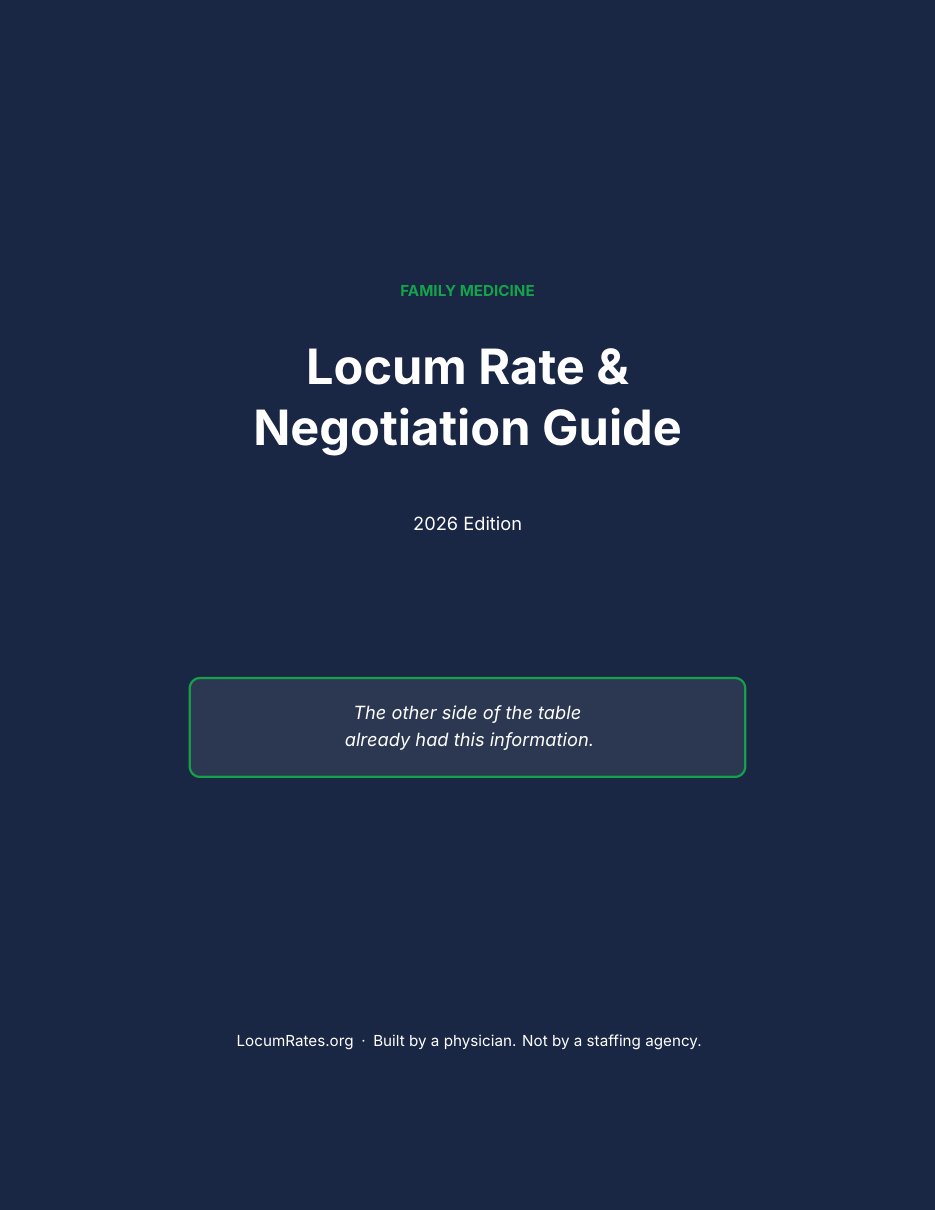
The sample contains three pages drawn directly from this specialty's 2026 toolkit: the cover, the actual national and regional benchmark page, and a specialty-specific leverage page.
The core negotiation framework is consistent. The rates, leverage points, contract risks, credentialing, and assignment guidance are built for Family Medicine.
Open the three-page sample →No email required. Real toolkit pages—not a separate brochure.
Market Snapshot
Is your current rate above or below the median? The full 50-state breakdown is in the toolkit.
Built for the decision in front of you
Use the same toolkit at three high-stakes moments.
First locum assignment
Use a clear path through the interview, credentialing, first shift, assignment problems, and exit.
Offer or contract in hand
Set the counter, use the exact language, and review the terms before the assignment becomes expensive to unwind.
Current assignment or renewal
Recalculate the effective rate, identify work creep, and rewrite the terms that mattered in practice.
What's Inside
A complete assignment toolkit:
- Rate Benchmark Database
Family Medicine rates by state and setting — urban clinic and rural/critical access — at the 25th, 50th, 75th, and 90th percentile. Fifty states. Includes FQHC and IHS rate context, which differ from standard locum placements.
- Recruiter Call Scripts
Word-for-word. The exact sentences:
- The opening anchor when you've received a below-market offer
- The multi-state licensing leverage script — how to price an existing license footprint or expedited licensing path when it materially shortens the start
- The rural premium script for CAH and frontier settings
- The FQHC/IHS script, where the federal contract structure requires a different framing
- The renewal script when they try to roll your old rate forward
- Family Medicine Leverage Points
The specific FM credentials and coverage capabilities that justify a higher rate:
- Existing state licenses and IMLC eligibility shorten the path to hard-to-staff assignments — price that faster start explicitly
- OB-trained FM is the single most valuable credential for rural CAH assignments requiring labor and delivery coverage — worth $40–60/hr above the standard FM rate
- POCUS certification is now standard in competitive urban FM locum markets and a differentiator at rural sites without dedicated ultrasound support
- Frontier and IHS settings carry federal contract structures with different leverage dynamics — productivity benchmarks and rate structures differ from standard locum placements
- Contract Red Flag Checklist
Productivity requirements, patient volume caps, housing and travel stipend structure, malpractice coverage, and FQHC-specific scope restrictions. One page, annotated.
- Agency Markup Framework
FM locum placements often carry higher percentage markups than procedural specialties. Knowing the spread between your rate and the facility payment is the strongest anchor for any counter-offer.
- Locum Tax Framework
The 1099 math: S-corp threshold, Solo 401(k) gap, and the minimum premium to break even against an employed W-2 FM position — the comparison most physicians are actually making.
- Licensing & Credentialing Roadmap
The licenses, registrations, facility privileges, documents, start gates, and timelines required for the assignment.
- From Signed Contract to Final Shift
A specialty-specific first-shift gate, assignment escalation scripts, a stay/pause/leave framework, and a final-shift checklist.
What It Looks Like on the Call
When a recruiter quotes $178/hr for a rural South clinic assignment, this is the sentence from Section 2:
"The rural FM median for this region is $192/hr. I'm already licensed in this state, and my OB training expands the coverage I can provide. I'd expect to be in the $215–230 range for a rural critical access assignment. Is there flexibility before we get into scheduling?"
You change the numbers to match your state. You say it. That is the product.
Who Built This
For years I took every rate I was offered without pushing back. Not because I was naive. I did not have the data to know whether I should. Neither did anyone I trained with.
I built the same rate model and negotiation framework across 22 physician specialties, then added the contract, credentialing, first-shift, and assignment protections I would want before accepting the work myself.
The agency has this organized. Now you do too.
Built on Evidence, Written for the Call
The toolkit combines 50-state benchmark data, specialty-specific assignment research, current licensing and tax guidance, and 17 peer-reviewed negotiation sources. The research establishes the framework; the product gives you the number, language, and checklists to act on it.
What $99 Has to Do
One $10/hr improvement on one 10-hour shift covers the full price. One avoided unpaid hour can do the same. Every protected shift, corrected contract term, or future renewal comes after that.
46–48-page PDF · Instant download · No subscription.
One Honest Limitation
This will not help you if you are already negotiating above the 75th percentile for your specialty and state. If you don't know what percentile your current rate is, that is the problem this solves.
About the Data
Based on BLS OEWS public data and CMS geographic adjustment factors, processed through a locum-adjusted model, calibrated and validated against publicly posted rates and observations.